
Stephen Rayment
Founder, CEO & Group Managing Director
Founder, CEO & Group Managing Director
On a major infrastructure project, the point at which an employer and a defaulting contractor sit down to negotiate a supplemental agreement is rarely the end of the story. It is, more often, the beginning of the part that matters most: will the contractor actually deliver what it has just promised?
Most supplemental agreements are built the same way. Lawyers and commercial teams negotiate relief, extensions of time, revised milestones, bonus and penalty regimes, and sometimes a partial commercial reset. The document that emerges is usually legally sound and commercially considered. But it rests on an assumption that is too often untested: that the contractor’s recovery programme is achievable. That assumption is where many settlements quietly start to fail. Months later, the employer finds itself back in the same position, renegotiating relief against a milestone that was never realistic in the first place, only now with less leverage and less goodwill on either side.
When an employer has already experienced default, its concerns are rarely about legal drafting. They are about capability and credibility. Has the contractor genuinely reset its resourcing? Has it addressed the root causes of the original delay, or simply reprogrammed around them? Is the recovery sequence logically sound, or does it rely on compressed durations and unproven productivity rates to make the numbers work? These are project controls questions, not legal ones. Yet they are frequently left unanswered, or answered only superficially, before a settlement is signed. The result is a supplemental agreement that looks robust on paper but is built on a programme that was never independently stress-tested. This gap matters because the two disciplines are usually negotiated in parallel. The legal and commercial teams focus on relief, liability and consideration; the contractor’s planners focus on producing a programme that supports the dates being discussed. Rarely does anyone independently ask whether that programme could be built in the real world, with the resources, productivity and sequencing it assumes.
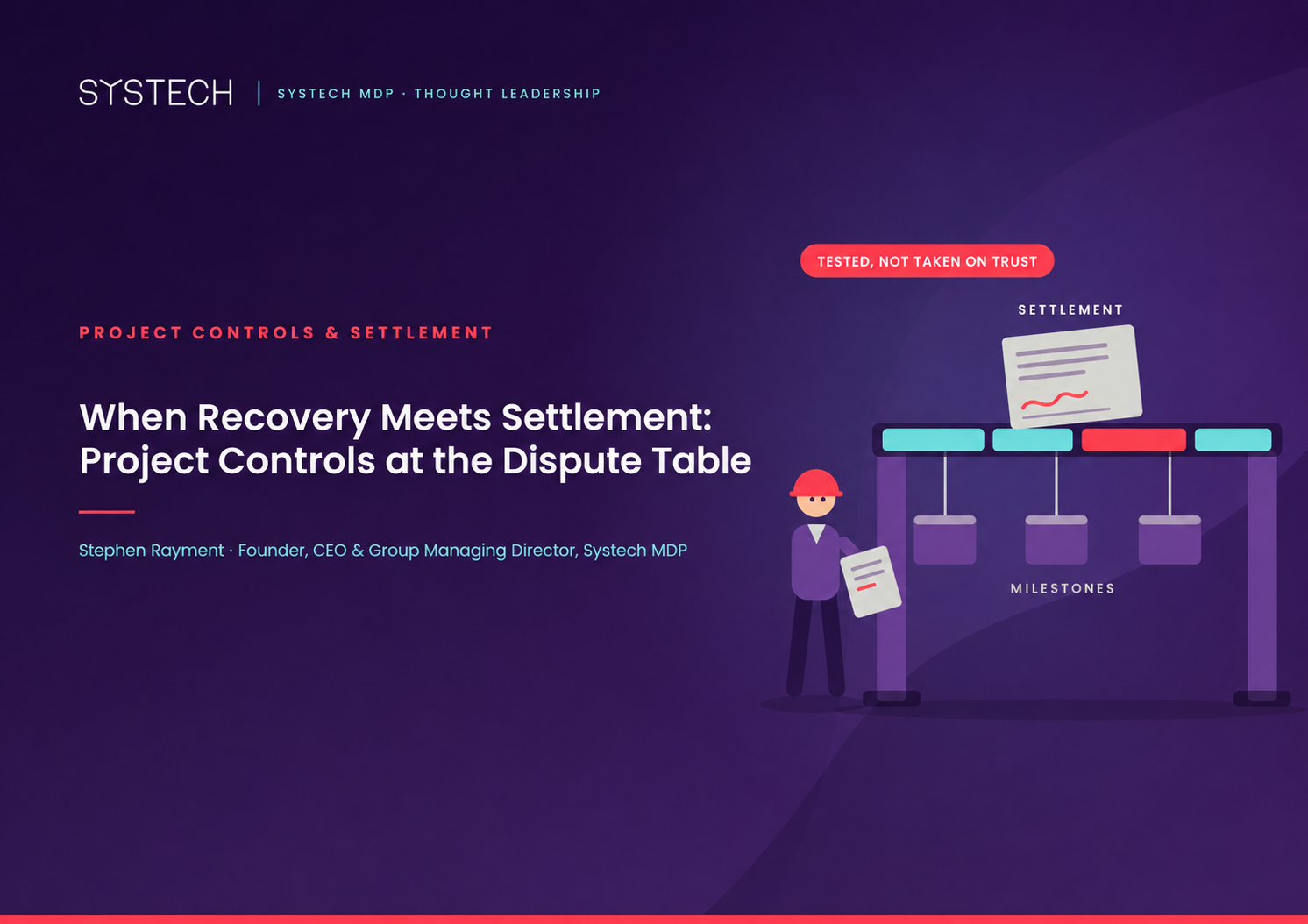
Systech’s view, formed across major infrastructure and complex claims work, is that a supplemental agreement is only as strong as the recovery programme underneath it. Commercial terms (milestone payments, liquidated damages regimes, step-in rights, bonus mechanisms) should be calibrated against a schedule that has been rigorously tested, not one that has simply been accepted at face value.
This is where our project controls capability adds real value. We bring the same forensic discipline we apply to delay and disruption analysis to the recovery programme itself: examining logic, resource loading, calendar assumptions, productivity rates and float erosion, and testing all of it against the contractor’s demonstrated track record on the same project. Where a recovery programme assumes productivity gains that the contractor has never actually achieved, or compresses activities beyond what its own historical data supports, that is a red flag an employer needs to see before signing, not after the next missed milestone.
THE ASSUMPTION
A supplemental agreement is only as strong as the recovery programme underneath it.
In practice, this means interrogating several things before a supplemental agreement is finalised:
Logic and sequencing. Does the recovery programme reflect a genuine re-plan, or has it simply compressed the existing logic to hit a date? Poorly substantiated logic changes are one of the clearest signs of an aspirational programme.
Resourcing reality. Has the contractor demonstrated it can mobilise the labour, plant and supply chain capacity the recovery plan assumes? A programme that requires resourcing levels the contractor has never sustained is a programme built on hope.
Productivity assumptions. What productivity rates does the recovery plan rely on, and how do they compare with the contractor’s actual output to date? Optimism bias in productivity forecasting is one of the most common, and most damaging, features of recovery programmes.
Float and risk allowance. Has genuine contingency been built in, or has float been quietly stripped out to make the numbers work? A zero-float recovery programme is rarely a resilient one.
Milestone credibility. Are the specific milestones being negotiated in the settlement actually achievable against this tested programme, or are they simply the dates the contractor is asking for?
The value of this analysis is not purely technical. It feeds directly into how the settlement itself is structured. A commercial settlement built on a stress-tested programme allows an employer to negotiate with confidence, knowing where genuine contingency exists, where the real risk sits, and which milestones deserve to carry commercial consequences if missed. It also strengthens the employer’s negotiating position: a contractor asked to substantiate its recovery programme against independent scrutiny is less able to over-promise its way into a settlement it cannot deliver.
Just as importantly, it gives the resulting agreement a defensible evidential basis. If the contractor subsequently defaults again, an employer who tested the recovery programme at the point of settlement is in a materially stronger position (commercially and, where necessary, in dispute) than one who took the programme on trust.
This matters just as much for the contractor side of the table. A recovery programme that has been independently tested and accepted gives a contractor a genuine platform to rebuild trust and demonstrate delivery, rather than a settlement that simply defers the same argument to a later date.
Sometimes the correct contractual answer is also the least useful one. Enforcing liquidated damages, calling on a bond, or issuing notices of default may be entirely justified, but none of it, on its own, recovers a late programme. On major public sector infrastructure projects, LADs rarely reflect the real cost of delay in any case. A pre-agreed daily rate was never designed to capture political attention, media scrutiny, disruption to public services, funding and franchise consequences, or reputational damage to the sponsoring body. Where the contractual remedy doesn’t match the true cost of delay, and won’t itself get the programme back on track, an employer needs an option beyond adversarial enforcement.
This is where Systech’s multi-disciplinary approach offers something contract administration alone cannot. Rather than confining our involvement to independent analysis and advice behind a settlement, we can position Systech project controls specialists to sit inside the contractor’s delivery team, working directly alongside its planners and construction management to help drive execution of the recovery programme itself. This is not oversight from a distance; it is active augmentation, placing capability where the contractor is weakest, rather than simply reporting on the gap.
This is grounded in direct experience of how public sector bodies actually operate. Systech provides project controls consultancy services directly to public sector clients across the UK, Canada, Australia and the Middle East, and understands the scrutiny, governance and accountability those bodies are held to when a major programme runs into difficulty.
Where necessary, that augmentation extends beyond advice and analysis to genuine resourcing. If a contractor’s own planning and project controls function is not capable of delivering the acceleration, re-sequencing or compressed working the recovery programme demands, Systech can supply the additional project controls resource required to make that programme achievable: embedded planners, schedulers and progress reporting capability working to the contractor’s programme, under its management, but bringing the capacity and discipline the contractor currently lacks. In effect, Systech becomes part of the solution the settlement is designed to secure, rather than simply the mechanism that tests whether the contractor’s own solution stands up.
For an employer negotiating a supplemental agreement, that changes what the settlement can actually achieve. Rather than relying purely on commercial incentives (bonus and damages regimes) to persuade a struggling contractor to perform, part of the agreement can directly reduce delivery risk, by resourcing the recovery rather than just measuring it. That combination of commercial settlement and embedded delivery support is, in our experience, often the difference between a recovery programme that stays on paper and one that actually happens.
THE DIFFERENCE
Resourcing the recovery rather than just measuring it.
Positioning Systech resource inside a contractor’s delivery team, at the employer’s instigation, raises a fair question: does that arrangement compromise Systech’s ability to act independently if the project later moves into dispute? We treat this as a governance point to be addressed explicitly at the outset of any engagement, not a trade-off to be managed around later. In practice, that means agreeing the embedded team’s scope, remit and reporting lines in writing before the work begins, distinguishing delivery-support work, helping build, monitor and drive the recovery programme, from any subsequent expert or legal work Systech may be asked to provide.
Where a later dispute requires independent expert opinion, that work is carried out by a separate team within Systech’s MDP, insulated from the embedded delivery team by clear information barriers, in the way conflicts are managed routinely across professional services firms. The employer retains full visibility of the embedded team’s findings throughout, so the arrangement’s assurance value is preserved even where a genuinely independent team is later required.
This separation matters because the credibility of independent expert evidence depends on it being seen as independent, not as a continuation of work commissioned to help deliver the contractor’s programme. Being explicit about that boundary, and building it into the engagement from day one, is what allows an employer to secure the benefit of augmentation now without undermining Systech’s ability to support a robust, independent position later, should one be needed.
This is precisely where Systech’s combination of project controls and dispute resolution expertise is designed to sit. We do not treat programme analysis and commercial settlement as separate workstreams handled by separate teams. Our project controls specialists work alongside our claims and commercial consultants so that the technical assessment of a recovery programme, the option to augment the contractor’s delivery team, and the drafting of the supplemental agreement all develop together, each informing the other.
For employers facing a defaulting contractor on a major infrastructure project, that means a settlement is not just a legal instrument recording what has been agreed. It is a commercially calibrated agreement, underpinned by a recovery programme that has been genuinely tested, not simply taken on trust.
To discuss how our project controls capability can support a settlement or recovery programme review, get in touch with the team.
Systech International is a specialist construction claims, dispute resolution and commercial management consultancy, working on major infrastructure and construction projects worldwide. This article is general commentary, not legal or commercial advice; any settlement or recovery programme turns on its own facts.
![The price of a definition – Network Rail Infrastructure Ltd v ABC Electrification Ltd [2019] EWHC 1769 (TCC)](https://systech.euwest01.umbraco.io/media/3ivb3ztk/price-of-a-def-4021.jpg)
Imagine millions of pounds relying on an interpretation of a single word. A single word to determine the meaning of a contract’s clauses and the placement of liab...

Mediation has been used as a method of resolving disputes since time began, however it was not until the 1990s that it become an accepted part of the legal proces...

As the cost of materials, transportation and labour rise globally, construction projects are feeling the bite of evaporating margins, constrained cashflow, and ex...